Low-carbon all-trade contractor for sustainable cities
Our objectives: aim for carbon neutrality throughout the industrial chain – from design to the end of the building's life – to mobilise all stakeholders: suppliers, subcontractors, customers, partners… and to reduce grey energy consumption.
Our method: favour the use of renewable energy, design and build better with less material, avoid and reduce the use of carbon-based materials and preserve carbon sinks. These are all key ways of reducing the carbon impact of construction and renovation.
Chairman and CEO, EiffageAs a designer and builder of sustainable cities and infrastructures, we want to harness the Group's expertise to formulate a truly low-carbon offering for sustainable cities and infrastructures.

Committed to a low-carbon future
Reducing the carbon footprint of buildings is based on a number of factors:
- energy sobriety through renovation, bioclimatic design, thermal insulation and equipment performance (reducing direct emissions from energy consumption by buildings in use)
- renewable energy from sea water thermal and geothermal energy, photovoltaic and wind-generated electricity, biomass boilers and heat pumps (reducing indirect emissions from the production of electricity, heat and cooling)
- the use of bio-based or geosourced materials (wood, plants, earth), the use of less concrete or concretes with reduced low-carbon emissions, the widespread recycling and reuse of materials (reducing indirect emissions from the manufacture of materials)
- reducing the impact of construction with factory pre-fabrication, short supply chain procurement, pooled support services, the use of virtuous materials (reducing consumption and indirect emissions by our work sites).
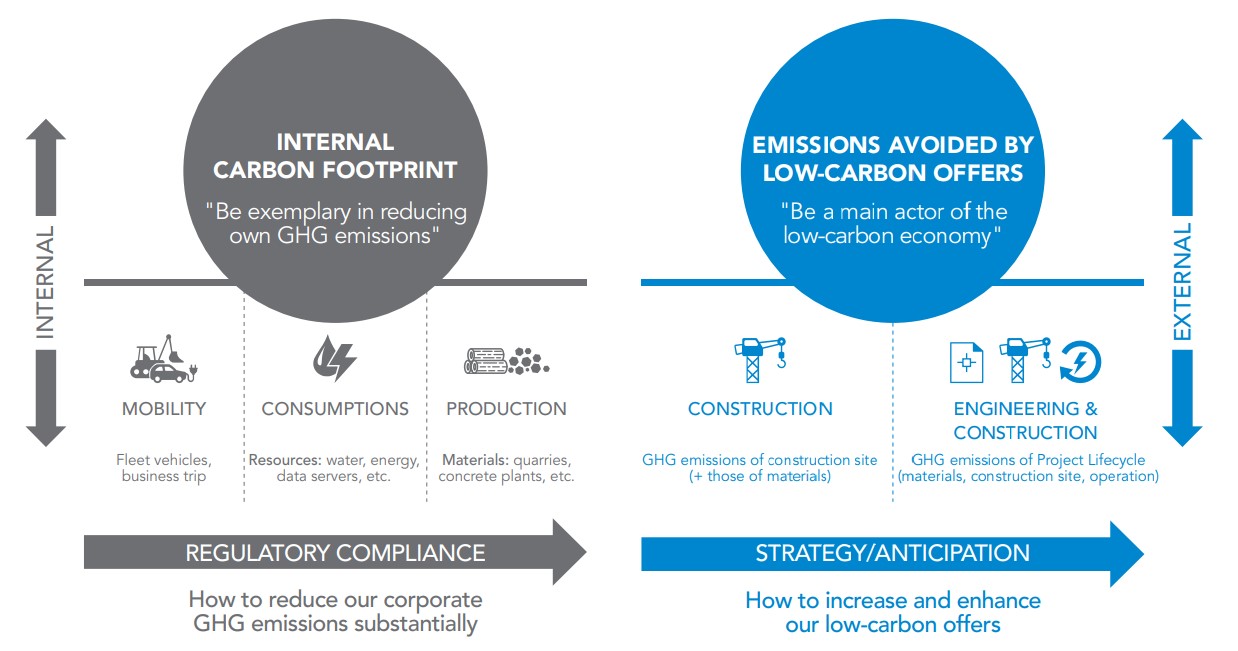
Detailled diagram description
This diagram compares and details two complementary approaches to carbon management at Eiffage: internal carbon footprint and emissions avoided by the offering.
Left Part: Internal Carbon Footprint (INTERNAL)
This section is dedicated to managing the company's own emissions, with the motto: "Being exemplary in our own emissions."
It is structured into three main categories, representing the sources of internal emissions:
- 1. Travel
- Description: Includes the vehicle fleet and employee travel.
- 2. Consumption
- Description: Concerns resources used such as water, energy, and IT.
- 3. Production
- Description: Includes materials from quarries, asphalt plants, etc.
Regulatory Compliance:
- Objective: Significantly reduce our internal emissions.
Right Part: Emissions Avoided by the Offering (EXTERNAL)
This section highlights the company's role as a player in the low-carbon transition, with the motto: "Being a key player in the low-carbon economy."
It is structured into two main categories, according to the scope of emissions avoided by projects:
- 1. In Construction Only
- Description: Takes into account emissions related to the construction site itself, plus those from materials.
- 2. In Design & Construction
- Description: Encompasses emissions over the entire life cycle of the building or structure, including materials, construction, and future operation.
Strategy / Anticipation:
- Objective: Increase and enhance our low-carbon offering.
Climate Report
Every year since 2020, Eiffage has published its climate report in accordance with the recommendations of the Task Force on Climate-related Financial Risk Disclosures (TCFD).
This report details:
- the way in which climate change is integrated into its governance, at the highest company level;
- its management of the physical and transitional risks associated with climate change;
- the chosen strategy and the sustainable business opportunities to be promoted;
- the management and audit tools used.
Low-carbon certification
The low-carbon drivers implemented have enabled Eiffage Construction to obtain the certifications justifying the carbon performance of our buildings: Positive Energy & Carbon Reduction Building (E+C-), Low Carbon Building (BBCA), Bio-Based Building, the latest Environmental Regulation 2020 (ER 2020) as well as anticipating its future thresholds but also meeting certain certification criteria: NF HQE™, BREEAM, LEED.
The national objective is to reduce direct and indirect emissions by 40% by 2030 (-75% by 2050).
Eiffage is directing innovation and R&D in this direction. An approach initiated in 2007 with Phosphore, the sustainable city laboratory. The measurement of CO2 equivalent emissions and their ongoing optimisation are also part of this transition.
Our low-carbon solutions
Eiffage Construction implements efficient low-carbon construction solutions at every stage of our construction projects, from design to completion and throughout the life cycle of a building.
Conscious of the environmental impact of traditional building materials, over the pasty few years, Eiffage Construction has been developing solutions which promote a mix of low-carbon materials for its customers.
Projects using bio-based and geosourced materials (straw, wood, unbaked clay, etc.) are multiplying and attracting interest from architects and buyers alike.
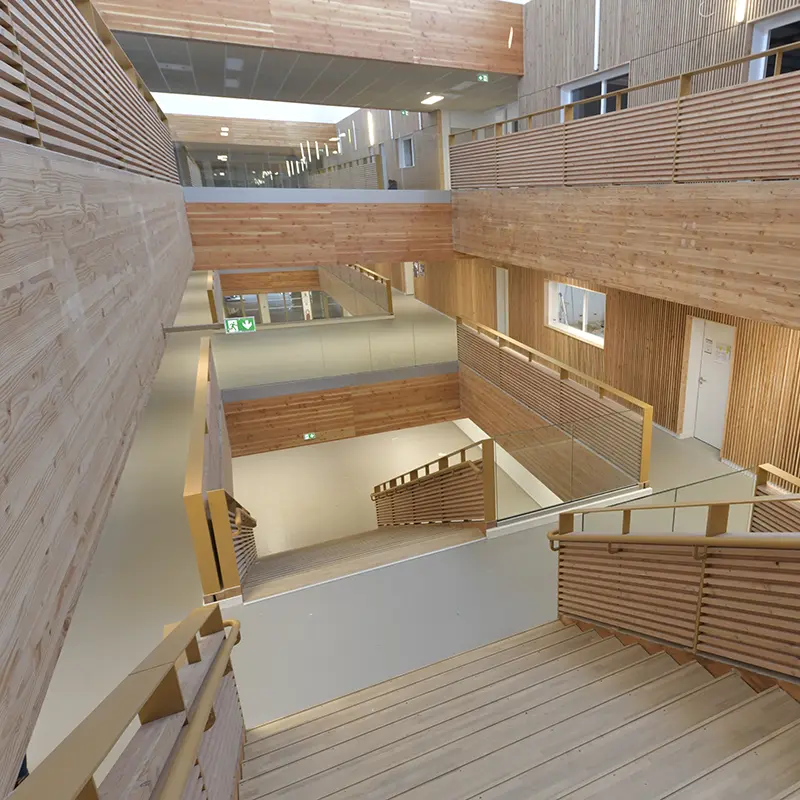
The lycée Gergovie in Clermont-Ferrand (Puy-de-Dôme) is a model of low-carbon construction. Delivered in July 2022, bio-based materials were taken into account from the design stage: 3,900 cubic metres of timber from the Massif Central mountain range were used to build 11,200 square metres of timber-framed walls and lay 12,900 square metres of flooring. 12,000 bales of Limagne straw were used to insulate the walls.
The facility is equipped with a wood pellet boiler for heating as well as 2,000 square metres of solar panels. The timber-framed walls were manufactured in a workshop 20 kilometres from the site.
Lycée Gergovie has been awarded level E4C2 of the E+C- label and the BBCA excellence label.
To ensure the traceability of the building materials used on its sites, Eiffage has developed a methodology that guarantees the origin of the materials, from the site to the area where the raw material was extracted.
Initiated in 2017 with wood, this pioneering approach has since been extended to other materials such as concrete and steel.
It is characterised by its flagship deliverable, the material label, which summarises various details on the extraction and processing sites and the nature of the material traced.
It is guaranteed by Product DNA, an independent auditor with expertise in supply chain traceability, based on tangible evidence gathered at every stage of the material's life cycle.
Selective deconstruction, reuse or recycling of materials… Our teams seek to optimise the use of raw materials right from the project design phase, and then to make responsible use of them (LaVallée eco-district, reconditioning workshops).
To achieve this, we give priority to material recovery processes, either in-house or in partnership with local organisations.
Find out more about our circular economy approach
Located in the heart of Bordeaux as part of the Bordeaux-Euratlantique urban development operation, Noé is an innovative work site platform, a sustainable city demonstrator created by Eiffage.
In line with the challenges of a low-carbon territory, it combines environmental performance (reduction of flows to minimise nuisance and impact, timber construction camp), traceability (shared services through a short supply chain) and circular economy (recycling and recovery of waste, reuse of excavated earth and materials).
Visit the Noé platform website
The demolished concrete is de-ironed, then crushed and ground before being reused as aggregate to make new concrete.
On the LaVallée eco-district project in Châtenay-Malabry, 98% of the concrete resulting from the deconstruction of buildings was reused on site.
Crushing directly on site meant that demolition rubble did not have to be transported by lorry (one lorry every 10 minutes for 3 months), but also that new aggregate was not purchased and transported to the site. In terms of environmental impact, 120 tonnes of CO2 were avoided.
The first phase of the eco-district delivered in 2022 incorporated up to 30% of recycled concrete in the superstructure concrete of the new buildings.
This new technique involves introducing CO2 under pressure into concrete aggregate waste derived from demolition.
Developed with Eiffage by the Institut français des sciences et technologies des transports, de l'aménagement et des réseaux (IFSTTAR), recarbonation can potentially store 50 to 100 kg of concrete, while the use of recycled aggregate saves the quarrying of 650 kg of aggregate for every tonne of concrete produced.
The concept is being tested industrially for the first time on the site of the LaVallée eco-district in Chatenay-Malabry, supported by Eiffage Aménagement. The operation will recover 100% of the demolished concrete from the former école Centrale.
Watch the video on the carbonation of concrete aggregates
How can we produce concrete with lower emissions?
Most of the CO2 emissions associated with cement and concrete result from the production of clinker, the main ingredient in traditional cement (CEM I).
Clinker is the binder that holds concrete together and represents over 90% of CO2 emissions from concrete. «Low-carbon» concretes aim to reduce the proportion of clinker in cement composition.
Low-carbon concrete is an innovative material that significantly reduces these emissions by replacing a part of traditional cement with alternative materials and low-carbon binders (clay powder, gypsum, blast furnace slag, recycled aggregates, etc.).
Standards are evolving, enabling us to use other types of concrete with a much improved carbon footprint. In just a few years, we have carried out experiments in all regions with less carbon-intensive concretes..
To meet our climate challenges, our low-carbon objectives, and the expectations of our customers and the market, Eiffage Construction has created a centre of expertise: the off-site solutions centre.
It brings together a wealth of expertise to meet all these challenges, as well as an innovative, diversified and tailored offering:
- industrial suppliers who are experts in their respective fields (Savare, B3 Ecodesign, HVA Concept)
- a specialist general contractor (Eiffage Construction Hors-Site, formerly Eiffage Construction Bois)
- a property development entity associated with these expert areas (Eiffage Immobilier Hors-Site)
Find out more
Promoting low-carbon solutions
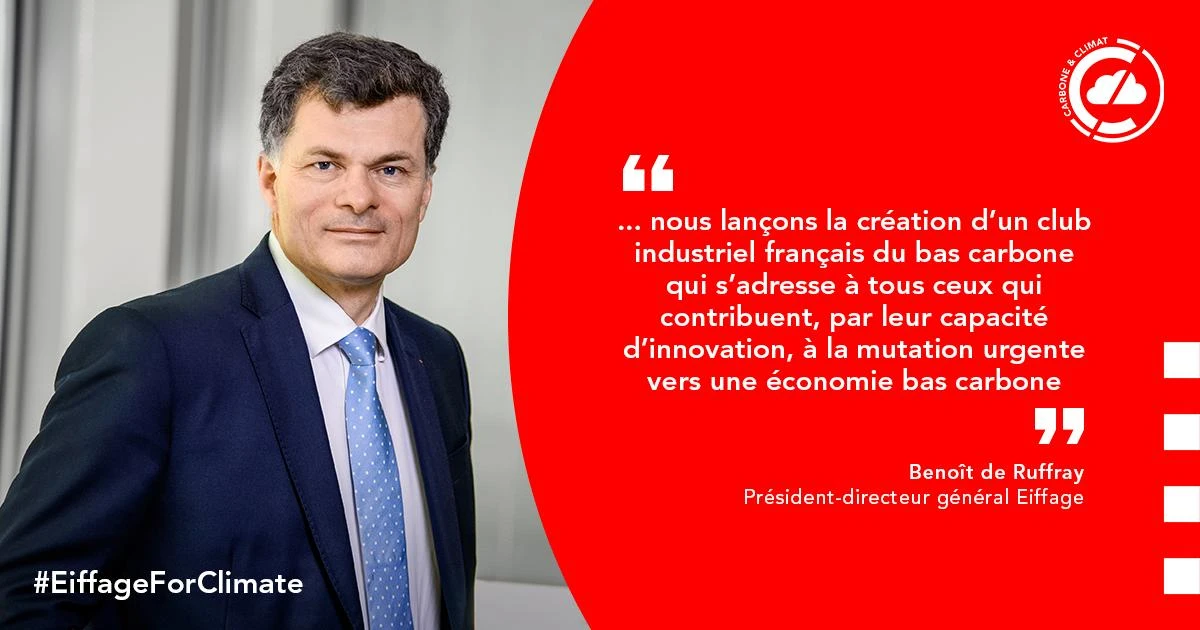
To promote low-carbon solutions, Eiffage provides financial rewards for innovations with low greenhouse gas emissions (E-Face scheme). Eiffage has also launched Sekoya, the first carbon & climate platform, dedicated to low-carbon materials and processes.
As a founding member of ADIVbois, the association for timber residential buildings, Eiffage Construction supports the development of the wood sector and contributes to E+C- testing. The company is also a founding member of the Association for the Development of Low Carbon Buildings (BBCA) and the French Institute for Building Performance (IFPEB).