
Preserving and respecting biodiversity
We are convinced that the construction of buildings should not be at the expense of biodiversity.
For this reason, we are committed to integrating the preservation and respect of biodiversity into every stage of our construction projects, from design to completion.
Biodiversity & construction sites: avoid, reduce, offsetPreserving the environment is an imperative that we take on board right from the design phase of a project, in the same way as planning, budget and legal issues.
This involves strict application of the regulatory sequence "Avoid, Reduce, Offset" (ARO), which is the guideline for the construction of all our projects, or the introduction of tangible and innovative schemes to raise awareness among our employees.
To avoid damaging a natural habitat such as a watercourse, woodland, pond, meadow, wetland, etc., Eiffage strictly complies with the regulatory Avoid, Reduce, Compensate (ARO) sequence and implements specific actions, which are planned right from the project design phase and make it possible, for example, to bypass sensitive natural areas. The first step is to avoid the impact of our activities on species and natural environments as far upstream as possible.
If the negative impacts cannot be wholly avoided, the promoter/builder takes suitable measures to reduce them. This is done, for example, by integrating wildlife shelters in the building structure (nesting boxes, bat boxes, etc.) or outdoor spaces, or by adapting outdoor lighting to minimise light pollution that is harmful to nocturnal species. In this way, right from the start of the activity, we make our best efforts to reduce the environmental footprint, the level of pollution and impact on wild fauna and flora.
Finally, if residual impacts are identified, they need to be assessed and then compensated for in kind, so that the project causes no "net loss" of biodiversity over time.
Preserving the environment is an imperative that we take on board right from the design phase of a project, in the same way as planning, budget and legal issues.
This involves strict application of the regulatory sequence "Avoid, Reduce, Offset" (ARO), which is the guideline for the construction of all our projects, or the introduction of tangible and innovative schemes to raise awareness among our employees.
To avoid damaging a natural habitat such as a watercourse, woodland, pond, meadow, wetland, etc., Eiffage strictly complies with the regulatory Avoid, Reduce, Compensate (ARO) sequence and implements specific actions, which are planned right from the project design phase and make it possible, for example, to bypass sensitive natural areas. The first step is to avoid the impact of our activities on species and natural environments as far upstream as possible.
If the negative impacts cannot be wholly avoided, the promoter/builder takes suitable measures to reduce them. This is done, for example, by integrating wildlife shelters in the building structure (nesting boxes, bat boxes, etc.) or outdoor spaces, or by adapting outdoor lighting to minimise light pollution that is harmful to nocturnal species. In this way, right from the start of the activity, we make our best efforts to reduce the environmental footprint, the level of pollution and impact on wild fauna and flora.
Finally, if residual impacts are identified, they need to be assessed and then compensated for in kind, so that the project causes no "net loss" of biodiversity over time.
Our construction business lines are faced with increasingly significant climate and biodiversity challenges. Considering the integration of our buildings into their surroundings, limiting land cover change, facilitating water infiltration, bringing nature back into urban environments and ecological connectivity, will help us move towards a greener, more pleasant and more resilient city.

Eiffage Construction's objectives and actions in favour of biodiversity:
- Improve the biodiversity knowledge of the site
Ensure a flash ecological assessment by an in-house or external environmental expert, from the development phase onwards in the planning and property sectors, as well as on design and build operations if environmental data is missing from the consultation file.
- Draw up a set of landscape specifications
Provide a contractual biodiversity appendix for the landscape design of all operations.
- Limit land cover change on our projects
Optimise our designs to limit the amount of land occupied, and restrict land cover change as much possible on sites.
- Raise awareness among local authorities and future residents concerning the site's ecological challenges and the environmental management of parks and gardens
Send all housing managers, housing programmes and condominium associations a guide to environmental maintenance of parks and gardens appropriate to the project, for operations completed within the year.
- Improve the recovery of excavated soil on or off site and moving towards a balance between excavated soil and backfill material
- Use wood from sustainably managed forests
100% of the wood purchased is PEFC or FSC certified for specified materials (from 2024).
- Identify and limit the spread and movement of Invasive Alien Species (IAS) on and off our work sites
Comply with IAS management procedures on all operations.
- Reduce light pollution from our projects
In the design phase, outdoor lighting should be directed towards the ground and have a colour temperature that has little impact on nocturnal fauna. The same approach should be adopted for our permanent sites and for temporary lighting during the construction phase.
A Group biodiversity strategy structured around four pillars
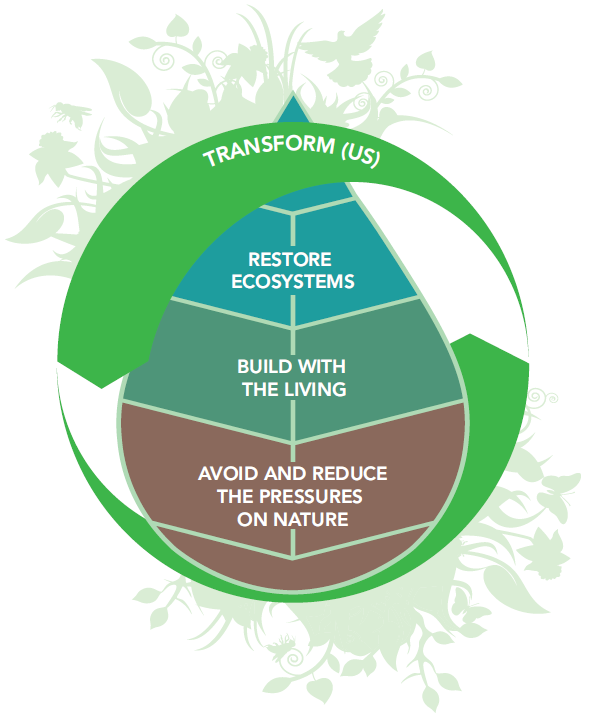
Our strategy is organised around four ambitious, complementary pillars which aim to:
-
Secure the avoidance and reduction of impacts on nature in our practices (pillar 1, the cornerstone of our strategy)
-
Add value in terms of biodiversity in our operations (pillar 2)
- Accelerate the restoration of ecosystems through the development of green activities (pillar 3)
- Disseminate a responsible approach to transforming the Group and its practices (pillar 4)
The first three focus on the transition of our activities. Pillars 1 and 2 concern the core activities of Eiffage, for which the first priority is to avoid and reduce impacts on living heritage (pillar 1), before adding value to biodiversity (pillar 2).
Pillar 3 aims to diversify the Group's activities through the development of new business lines in support of living heritage, such as soil rewilding.
The fourth and final pillar, which surrounds the previous ones, is based on change management and continuous improvement through training, CSR and research.
Biodiversity: a long-term Group approach
Fully aware of what is at stake for future generations and of its duty to act, Eiffage has been committed to biodiversity since 2009:
- 2009: Creation of the Master BIOTERRE (Biodiversity Territory and Environment) degree course with the University of Paris I Panthéon Sorbonne, on biodiversity, territory and environment issues in the design-construction-operation activities for development and infrastructure projects.
- 2010: commitment to the "Countdown 2010" initiative alongside the International Union for Conservation of Nature (IUCN) Europe
- 2010: Implementation of the Eiffage charters on "Biodiversity" and "Water and Aquatic Environments", anchoring biodiversity protection as a strong ambition for the Group
- 2012 to 2018: commitment continuously recognised by the Ministry for Ecological Transition as part of the National Strategy for Biodiversity (SNB), following on from France's commitment under the Convention on Biological Diversity. Two 3-year action plans were developed and implemented between 2012–2015 and 2015–2018.
- 2018 to 2020: programme of actions recognised under the Act4Nature programme.
- 2020 to 2022: by submitting its 2020–2022 biodiversity action plan to the French Agency for Biodiversity (OFB), Eiffage formalised its biodiversity roadmap and the commitments made for two years as part of the "Companies committed to nature - act4nature France" approach.
- 2023 to 2025: a new, broader commitment was made to the OFB for a three-year period, this time involving all Eiffage business lines.