
Resources and the circular economy
As part of its commitment to the ecological transition, Eiffage has implemented a circular economy approach for several years, which has led to the formal definition of a fully-fledged strategy. As a result of its genuine awareness of the environmental emergency, the Group is committed to reducing the use of raw materials and preserving natural resources.
Circular economy: strengthening reuse and recycling solutions
Reuse, selective deconstruction, materials recycling… In terms of the circular economy, Eiffage seeks to optimise the use of products and materials from the project design phase onwards, and then to use them in an environmentally responsible manner.
To achieve this, we give priority, either in-house or in partnership with locally-based structures, to material recovery processes in the broadest sense, with an emphasis on reuse where possible.
An increasingly stringent regulatory environment
In terms of the circular economy, the European and French regulatory context became clearer from 2015 onwards, with the publication of several long-awaited implementing texts:
- 2015: definition of the term "circular economy" in the Law on Energy Transition and Green Growth (LTECV); development of the Circular Economy Package, which led to a European protocol for the treatment of construction and demolition waste in 2016;
- 2018: The European Union published a report on the links between critical materials and the circular economy, following a dedicated circular economy package. An update of the 2008 Waste Directive was also published to promote economic tools to encourage the application of the treatment hierarchy and the associated recovery targets;
- 2020: Incorporation of an EPR (Extended Producer Responsibility) sector for construction products and materials (PMCB) in the Agec law (fight against waste and for a circular economy).
- 2022: The RE2020 was extended to office buildings and a digital traceability system became compulsory for hazardous waste. Reuse is now considered to have zero carbon emissions;
- 2022: inclusion of the circular economy in the six criteria defining a sustainable economy within the meaning of the CSRD (Corporate Sustainability Reporting Directive), in line with the European green taxonomy.
- 2023–2024: Ademe supported a project on securing reuse practices and associated guarantees, bringing together multiple players in the construction sector.
The PMCB EPR sector was introduced, with a target of a 5% reuse rate for 2028.
A committed Group involved in the circular economy
In direct line with our strategic commitments to low-carbon construction as well as our objectives of preserving and respecting biodiversity, Eiffage is committed to a circular economy approach that was formalised in 2019 through a dedicated charter. The charter has two operational pillars:
- eco-design of our structures and work sites;
- materials recovery, reuse and recycling.
Between 2020 and 2022, Eiffage has significantly deepened its approach to the circular economy, involving all the Group's business lines that are stakeholders in the material cycle (Construction, Energy Systems, Civil Engineering, Roads), in conjunction with the Procurement Department and the Sustainable Development and Transversal Innovation Department (DDDIT).
This collaborative work has helped to formally define Eiffage's circular economy strategy.
Circular economy: maximising recovery
Selective deconstruction, reuse or recycling of materials… Our teams seek to optimise the use of raw materials right from the project design phase, and then to make responsible use of them (LaVallée eco-district, reconditioning workshops). To achieve this, we give priority to material recovery processes, either in-house or in partnership with local organisations.
LaVallée: a low-carbon eco-district demonstrator for our circular economy approach
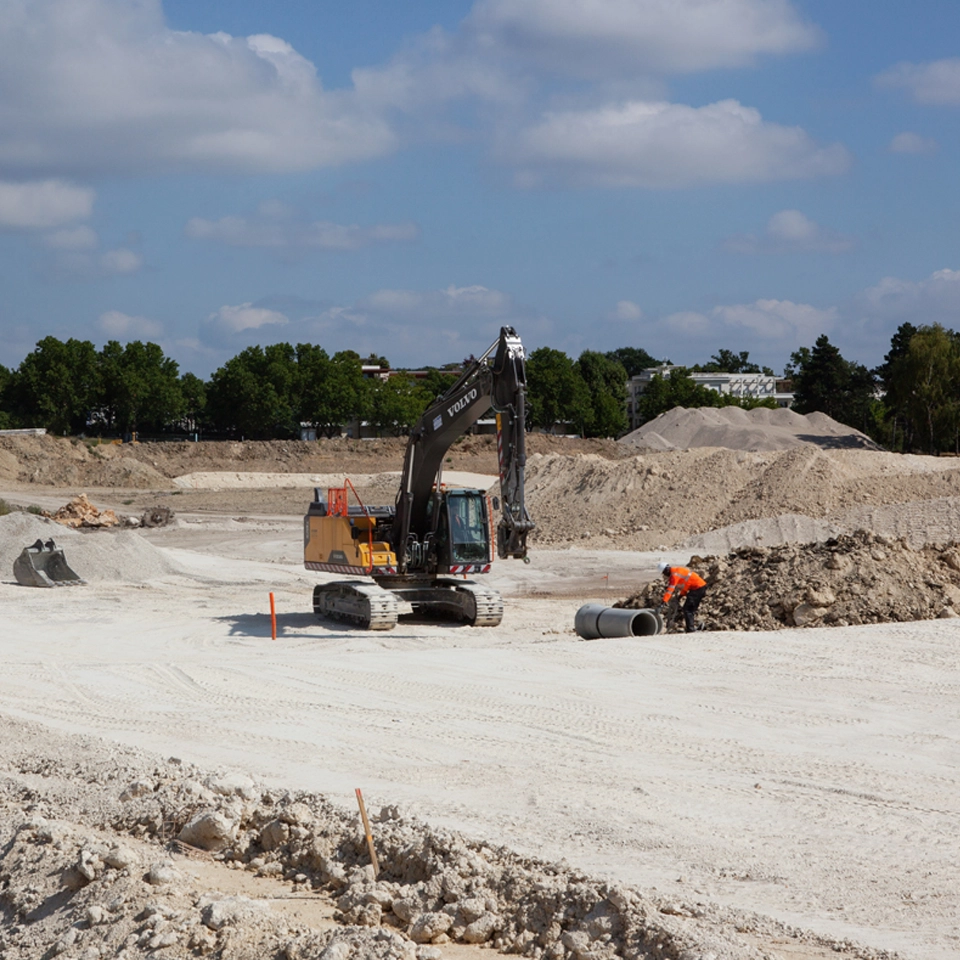
As part of the future LaVallée eco-district in Châtenay-Malabry (Hauts-de-Seine), sponsored by Eiffage Aménagement, a large-scale circular economy demonstrator was set up in 2018 to ensure the selective deconstruction of the former école Centrale building.
Firstly, a "resource diagnostic" was carried out prior to the deconstruction phase of certain buildings at the former école Centrale. The aim was to identify the potential for reuse of the finishing work (light fittings, doors, sanitary facilities, handrails, emergency units, etc.) in order to salvage as much as possible. What was once seen as waste to be processed has become a source of materials to be recycled.
As a result, right from the call for tenders phase for the clearance and demolition, Eiffage Aménagement encouraged its partners to give priority to the selective deconstruction of the buildings concerned, in order to improve the quality of the materials and products removed for recovery. Crushed and recycled, 98% of the concrete resulting from the deconstruction of the buildings was reused on site. The first phase of the eco-district, delivered in 2022, incorporated up to 30% of recycled concrete in the superstructure concrete of the new buildings.
With LaVallée in Châtenay-Malabry, we have gone much further than is usually the case, by setting up a large-scale circular economy circuit for the reuse of deconstruction materials.
Direct and indirect reuse of materials
The best waste is the waste we don't produce!
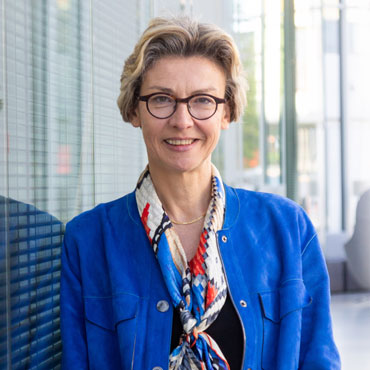
The reuse of materials aims to recover demolition waste and reduce the use of virgin raw materials, or even avoid their production.
L1ve: an exemplary project in terms of reuse
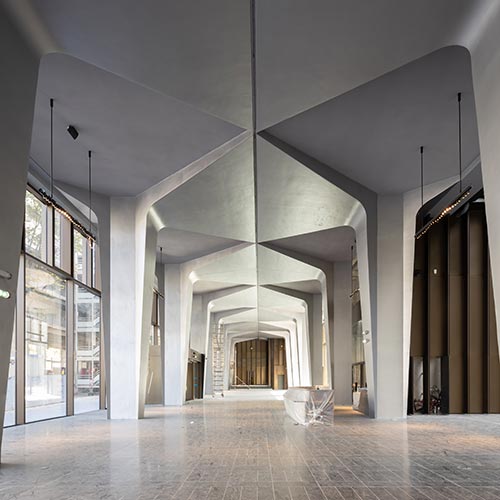
The major refurbishment of Peugeot's former headquarters – renamed L1ve and located at 75 avenue de la Grande Armée in Paris – is a model in terms of the circular economy and reuse.
Three materials have been recovered and reused:
- Cable trays: the Réavie association removed and supplied cable trays that it reconditioned in its integration workshop located in La Courneuve (Seine-Saint-Denis), for a carbon saving of 384 kg of CO2 eq.
- Technical flooring slabs: Mobius recovered 2,700 m² of raised flooring from a clean-up site in Dijon, which it processed and reconditioned in Ile-de-France for a carbon saving of 196,830 kg of CO2 eq.
- Floor coating: the 835 m² of green Labrador granite removed from the façade were reprocessed and transformed to be reused as floor tiles, for a carbon saving of 59,580 kg of CO2 eq.
RéaVie: reuse of building materials, social enterprise and awareness-raising
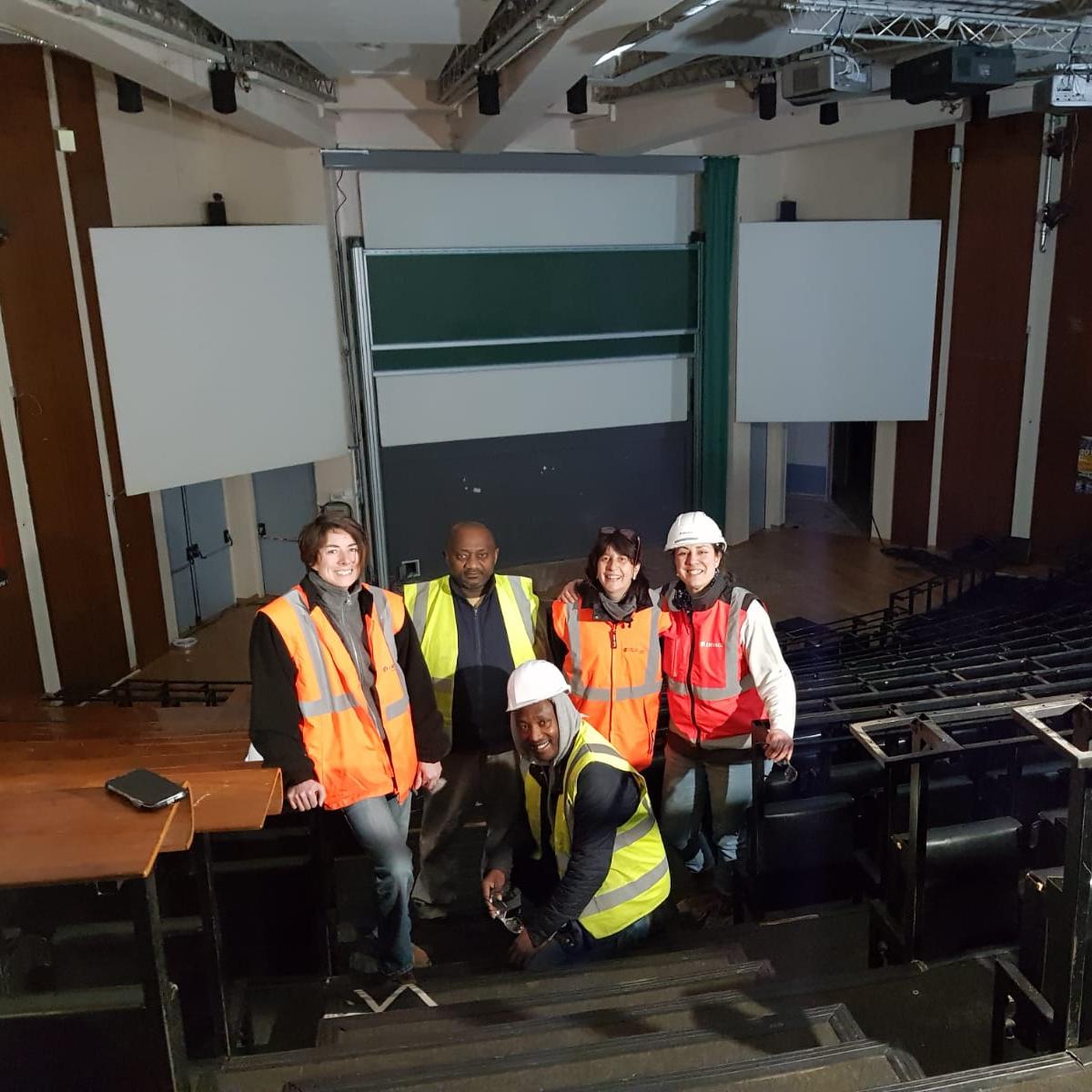
Eiffage supports the work of a number of associations, including RéaVie in the île-de-France region, which was co-founded by professionals from the construction and public works industry. It helps to safeguard hundreds of products, equipment and materials by encouraging their reuse.
An experimental recycling platform called Solid'R has even been set up on the site of the Châtenay-Malabry eco-district (formerly the école Centrale Paris campus). The materials were collected, sorted, repaired and reconditioned before being sold to associations or individuals on low incomes. Some have also been transformed by the sewing and carpentry workshops, notably the curtains in student bedrooms.
To further combine the circular economy and solidarity, seven amphitheatres were methodically removed to then be reconditioned and sent to Senegal in November 2018 for a solidarity project. They have found a new life at a new campus of the University of Sine Saloum El-Hâdj Ibrahima NIASS (USSEIN), dedicated to agriculture for food security, sustainable development and prosperity.
Pooling of uses and logistics for reuse
Synergies of mutualisation and substitution, which aim to pool certain needs or share certain resources or equipment, are an essential aspect of our strategy.
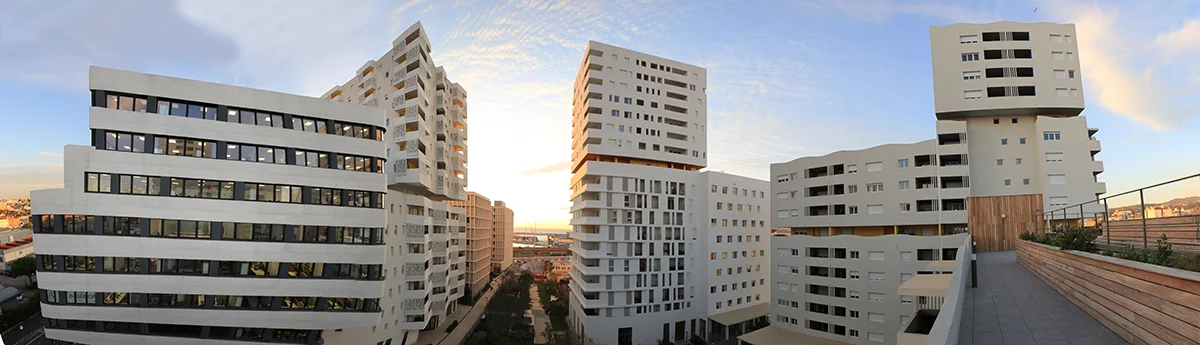
For this reason, we develop schemes for sharing services or uses, such as the Noé circular economy platform, or the concepts used in the Smartseille eco-district, as well as projects that integrate multiple uses directly, such as the Cocoon'Ages® housing scheme.
Solidarité énergétique®: the seawater loop
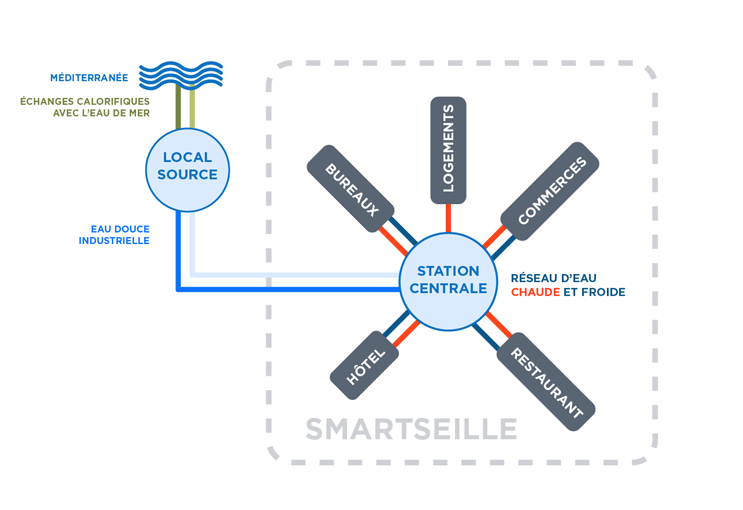
Based on the principle of energy solidarity® designed by Eiffage as part of the Phosphore project, Smartseille has a heating network that enables heat to be exchanged between buildings.
In other words, calories from office buildings can be used to heat homes, and vice versa.
Connected to the seawater loop installed by EDF, the system heats and cools living spaces by heat exchange with the sea, generating energy savings of 30%.
This makes it possible to obtain low-carbon energy that is protected from variations in the price of fossil fuels.
Cocoon'Ages® intergenerational residences, shared spaces
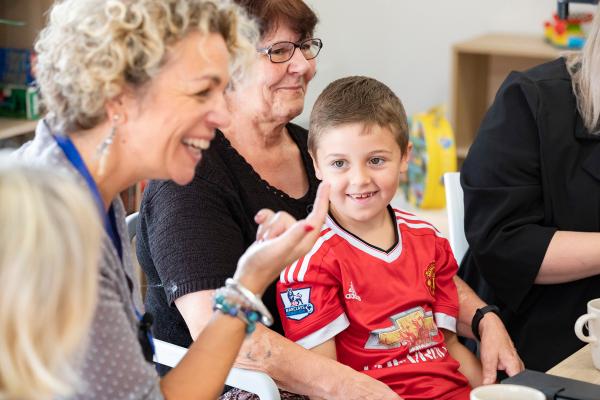
Cocoon’Ages® is an intergenerational residence programme that blends adapted architecture with a coordinated services offering. It helps to establish synergistic relationships based on solidarity and proximity, and to alleviate situations of fragility.
The residences are accessible and suitable for seniors and the frail, thanks to their location close to shops, services and transport, and their ease of access. Shared areas (garden, kitchen), ideal for socialising, are made active by daily support (project house to host all kinds of activities, manager-coordinator's office).
Noé, a physical platform for the circular economy
Noé is a physical circular economy platform that brings together and pools the needs of 170 member companies (VSEs/SMEs, demolition companies, public works, etc.), providing them with a wide range of services that reduce lorry turnaround and the risk of congestion: training, management of rubble and backfill, further sorting for waste treatment and traceability.
Commissioned in Bordeaux as part of France's largest urban development project – 2.5 million m² to be built over 20 years – the platform provides a tangible solution to the risks of congestion and carbon emissions associated with the construction site.
Noé is a highly innovative tool, enabling current methods of organisation to be adapted to the constraints of building in dense urban areas, while achieving genuine environmental performance.
L’ élément suivant est une vidéo The Noé platform explained in video
Atelier Lavoisier – Refurbishment and reuse of materials in the Bourgogne-Franche-Comté region
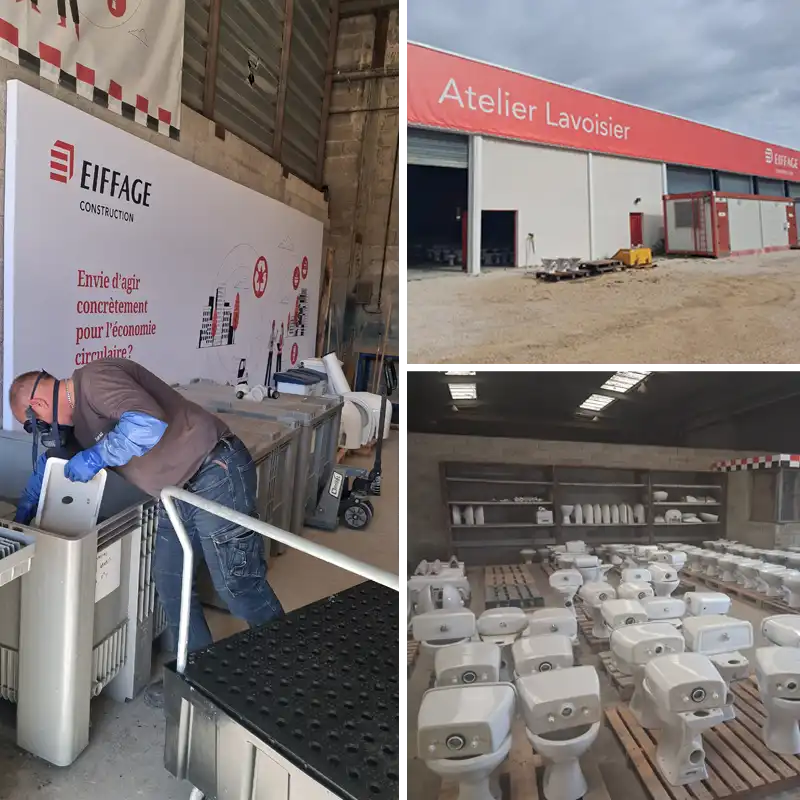
Opened in March 2025, the Atelier Lavoisier covers more than 800 m² in Longvic (21).
It recovers products from demolition sites and reconditions them for reuse in renovation or new construction projects.
The range of reconditioned materials includes several products: floor-mounted toilets, wall-mounted toilets, pedestal sinks, urinals, washbasins, etc.
In 2025, more than 450 sanitary fixtures were reused on regional construction sites, with the aim of doubling production in 2026.
This workshop enables Eiffage Construction to increase its supply of reusable products, thereby reducing waste from its construction sites and their carbon footprint!
L’ élément suivant est une vidéo Watch a video of the Rillieux-la-Pape refurbishment workshop
Reuse and the circular economy: how can we speed things up?
Watch the Replay of the show dedicated to reuse in construction.
Leading experts in the fields of the circular economy, construction and selective deconstruction were on hand to discuss the topic, including:
- Emmanuelle Ledoux, managing director of the Institut de l'Economie Circulaire,
- Nicolas Volckaert, director of legal affairs & institutional affairs at Entreprises Générales de France,
- Marie Massol, national reuse development manager at DEMCY, a subsidiary of Eiffage Génie Civil
- Gabriel Sibille, director of development and sustainable housing at Est Métropole Habitat,
- Jean-Christophe Terrier, director of environment & transformation and engineering at Eiffage Construction