
Timber construction, off-site construction, modular construction, mixed materials
With the development of timber construction (dry sector), off-site construction and the manufacture of prefabricated modules, Eiffage Construction aims to reduce its environmental impact, its carbon footprint, construction times and costs, to become more competitive.
The development of dry construction, combining steel, concrete and timber, plus the use of prefabricated building modules, illustrates Eiffage Construction's desire to innovate in construction methods. Our ambition is to combine efficiency, quality, safety and sustainability.
The benefits of timber construction
- Shorter work periods: no drying time, factory-produced materials ready for assembly as soon as they are delivered to the site,
- Lower energy consumption,
- Lower nuisance levels due to less machinery being used on work sites,
- Reduced losses and waste through the use of recyclable materials.
Within this dry sector, timber in particular offers a number of advantages:
- It is 5 times lighter than concrete,
- It transmits heat 10 times more slowly than concrete,
- 1 m3 of wood stores one tonne of CO2.
Mixed materials
Used on its own or in combination with concrete, glass and/or steel, timber can be adapted to any site: new build or refurbishment, residential or commercial, façade or extension.
Eiffage Construction uses all its expertise to offer turnkey projects incorporating the right material in the right place.
We supports its customers by adopting a project management approach tailored to each project and offers a complete package by managing the entire production chain from the design phase, thanks to its integrated design offices, right through to delivery.
Focus on timber-frame façadesTom Poulain, works manager at Eiffage Construction, explains the stages involved in installing timber-frame façades.
They are being supplied by our specialist wood subsidiary Savare, hosted on the site of the future Leonardo da Vinci university campus.
👷♂️ A technique that combines innovation, durability and expertise!
Tom Poulain, works manager at Eiffage Construction, explains the stages involved in installing timber-frame façades.
They are being supplied by our specialist wood subsidiary Savare, hosted on the site of the future Leonardo da Vinci university campus.
👷♂️ A technique that combines innovation, durability and expertise!
Modular construction and buildings made from shipping containers
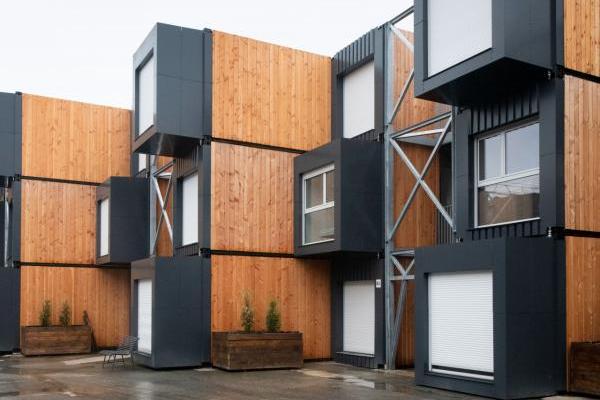
Amongst the approaches to reducing greenhouse gas emissions, modular construction using shipping containers has proved its worth.
B3 Ecodesign is a specialist in this process, which gives a second life to "last way" containers in the manufacture of three-dimensional modules, used to construct high-performance, relocatable, low-carbon modular buildings.
The buildings erected using this process – with reduced construction times – offer a wide range of architectural composition options as well as high energy and environmental performance.
Alongside the notion of upcycling (transformation with added value), acoustic and thermal comfort is a particular focus. Consumption is 20% to 50% lower than the RT 2012 environmental standard. The concept permits the award of Bepos certification.
Very low carbon concrete - concrete with a reduced carbon footprint
How can we produce concrete with lower emissions?
Most of the CO2 emissions associated with cement and concrete result from the production of clinker, the main ingredient in traditional cement (CEM I).
Clinker is the binder that holds concrete together and represents over 90% of CO2 emissions from concrete. "Low-carbon" concretes aim to reduce the proportion of clinker in cement composition.
Low-carbon concrete is an innovative material that significantly reduces these emissions by replacing a part of traditional cement with alternative materials and low-carbon binders (clay powder, gypsum, blast furnace slag, recycled aggregates, etc.).
Standards are evolving, enabling us to use other types of concrete with a much improved carbon footprint. In just a few years, we have carried out experiments in all regions with less carbon-intensive concretes.
Recarbonation of recycled concrete aggregates
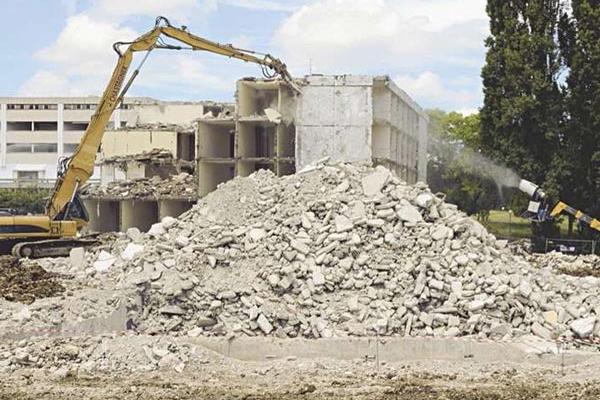
This new technique involves introducing CO2 under pressure into concrete aggregate waste from demolition work.
Developed with Eiffage by the Institut français des sciences et technologies des transports, de l'aménagement et des réseaux (IFSTTAR), recarbonation can potentially store 50 to 100 kg of concrete, while the use of recycled aggregate saves the quarrying of 650 kg of aggregate for every tonne of concrete produced.
The concept is being tested industrially for the first time on the site of the LaVallée eco-district in Chatenay-Mâlabry, supported by Eiffage Aménagement. The operation will recover 100% of the demolished concrete from the former école Centrale.